

Silicone or Saline: Have Your Fill

Even if you barely made it through high school science class, it's easy to understand silicone and saline basics. The first thing to know is that silicone is not the same as silicon, though the terms are related. Silicon is an element that's extremely common on Earth; in fact, it's just behind oxygen in terms of abundance on the planet. Silicone, which contains silicon, is a compound that's manufactured in many forms.

Silicone has a long list of attributes that make it attractive for many medical uses including silicone breast implants. It withstands huge temperature swings, it's flexible, it doesn't typically react when in contact with chemicals and it's low in toxicity. Silicone is used in artificial joints, heart devices, facial implants, drug delivery systems and more.

Saline solution is essentially salt water. It has many medical applications as well, where its most common form is a solution called "normal saline" that contains just less than 1% sodium chloride in sterile water. Normal saline is used for intravenous drips, nasal irrigation, contact lens storage and so on.

Want more specifics? Talk with one of our surgeons and save up to $150 on your consultation at select times when you request online.

Saline and Silicone Breast Implants Side by Side

Saline Implants Silicone Implants
Filling: 0.9% 'normal saline,' also called sterile isotonic saline Filling: cohesive silicone gel
Filling consistency: liquid Filling consistency: viscous, ranging from gooey to semi-solid; most patients believe silicone feels more like breast tissue
Sizing: most models are filled after insertion, allowing flexibility; some are adjustable after surgery Sizing: implants are filled (sized) and closed prior to insertion
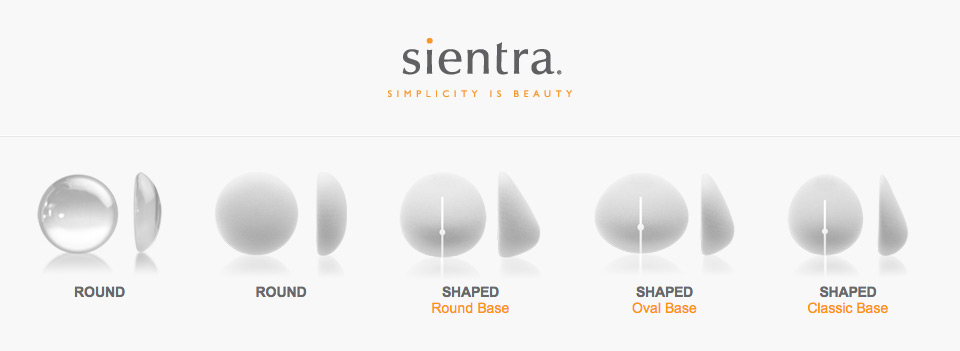
Shapes and covers: both round and anatomical are available with both smooth and textured shells Shapes and covers: round and anatomical are available; most have textured covers
Incisions: several sites are often possible; incisions may be smaller than for silicone implants Incisions: around the areola or underneath the breast; sometimes larger than for saline implants
Rupture: detectable almost immediately as the implant deflates; saline is harmlessly absorbed by the body Rupture: often undectable by the patient; periodic MRI tests are recommended to check for "silent rupture"
Rupture rates: Mentor states about 1% in one year and up to 10% in five years; Dr. Stevens' study of Mentor implants shows about 0.3% in one year and up to 5.1% in five years Rupture rates: Mentor and Allergan figures submitted to the FDA show 3-4 year rupture rates ranging from 0% - 7.7%
Other risks: rippling, capsular contracture, loss of nipple sensation, breast pain; normal surgical risks such as infection, swelling Other risks: capsular contracture, loss of nipple sensation, breast pain; normal surgical risks such as infection, swelling
Availability: augmentation patients 18 years old or older; reconstruction patients of any age Availability: FDA-approved implants available for augmentation patients 22 years old and older; reconstruction patients of any age

gummy bear implants under clinical investigation available to all women 18 years old or older as selected by their doctor

See and Feel for Yourself

Come in and meet the surgeons soon. If you're looking for a deeper discussion of implant fillings and their properties, Dr. Stevens and Dr. Stoker will be able to answer every question. Best of all, they'll give you a hands-on chance to examine implant samples for yourself. What better way to choose?

When you schedule your surgical consultation using our Inside Online system, you can request a FREE appointment at select times our surgeons have made available exclusively for Web visitors.

Send Us Your Questions

First Name: *
Last Name: *
How can we help you?
Phone Number: *
Email Address: *
Please email me about new developments and special offers!
Yes, I accept the Terms of Use.
Please enter the word Use this image to validate this form. in this field: *